
A Complete Beginner's Guide to Starting Yoga at Home
- Nidhi

- Apr 2
- 8 min read

Yoga is one of the very few practices where there is genuinely no prerequisite. You do not need flexibility. You do not need a particular body type, age, fitness level, or experience. You do not need a studio membership or a teacher standing in front of you. What you do need is a small amount of space, a surface to practise on, and the willingness to begin.
This guide is written for someone who knows almost nothing about yoga and wants to start at home. It is not a motivational pep talk. It is a practical, honest, detailed account of how to actually do that, including the parts that most beginner resources skip.
Before You Begin: What Yoga Actually Is-
Most beginners associate yoga primarily with physical postures (asanas). This is understandable, as it is what is most visible in social media, studios, and fitness marketing. But yoga, in its classical definition, is a far broader discipline. One of the most significant teachers of Yoga, Patanjali, defines yoga as the cessation of the fluctuations of the mind (Chitta Vritti Nirodha). Another teacher, Sage Swatmaram (Author of Hatha Yoga Pradipika) suggestsed 4 limbed practice and mentions the systematic practice of asana, pranayama, mudra, bandha, shatkarma, etc. Bhagawad Gita mentions Yoga as "Equanimity of mind".
Why does this matter for a beginner? Because understanding this context changes how you approach the practice. Yoga is not primarily about reaching your toes. The physical postures are a tool among many for training the nervous system, improving the quality of breath, balancing the emotions, and eventually attaining hightest potential of our existence.
When you understand this, you stop measuring progress by flexibility and start paying attention to subtler, more meaningful changes.
Setting Up Your Space-
You do not need a dedicated yoga room. You need roughly 6 feet by 4 feet of clear, level floor space, enough to lie down and extend your arms. A non-slip yoga mat is the one investment worth making; it prevents sliding during standing poses and provides cushioning for the spine during floor work.
A few things most beginner guides do not mention:
Temperature matters. But do not let it become an obstacle. A slightly warm room allows muscles to release more easily, and a cold room means you will need longer warm-ups and are more prone to strain. As a general principle, comfort supports consistency. In the beginning, especially, an uncomfortable environment is an easy excuse to skip practice. That said, do not let seasonal conditions become a reason to stop altogether. If your room is cold in winter, wear layers, extend your warm-up, and keep going. Strict environmental requirements have a way of quietly becoming obstructions to sadhana (that's why niyamagrah is mentioned as a badhak tatva in Hatha Yoga Pradipika). The practice matters more than the perfect conditions for it.
Lighting matters. Soft, natural light or dim artificial light is genuinely more conducive to practice than bright fluorescent lighting. It is not just aesthetic; the nervous system responds to light, and dim lighting activates the parasympathetic system, which supports the relaxation component of yoga.
Noise matters. Choose the quietest space and time available to you, early morning before the household wakes, a closed room, a balcony before the street gets busy. Every attempt during practice should be directed toward inwardness, and a quiet environment supports that. Avoid music entirely. The goal is to train the mind to go inward, not to give it something external to follow.
Your clothing matters practically, not aesthetically. Wear something that allows you to sit cross-legged, extend your arms overhead, and fold forward without restriction. You do not need specialised yoga clothing.
What Time Should You Practise?
Classical yoga texts recommend practising at Brahma Muhurta, approximately 90 minutes before sunrise, and this is not merely a cultural suggestion. The early morning hours, before the world wakes and the mind fills with the day's demands, are genuinely the most conducive time for practice. The stillness outside supports the stillness you are trying to cultivate inside. If you can build toward this, you should.
However, this takes time to establish.
Waking at Brahma Muhurta requires sleeping early, adjusting your entire daily rhythm, and building a level of discipline that does not happen overnight. Forcing it before you are ready often leads to irregular, resentful practice, which defeats the purpose entirely.
So in the beginning, choose a time that does not require force. A time that is natural to you, when you are already awake, already on an empty stomach, and not being pulled in another direction. Start there. Build consistency first. The shift toward earlier practice will come naturally as the practice itself deepens.
Remember, your discipline belongs to you alone. No teacher, no course, and no schedule can maintain it for you. The practice happens because you choose it, every single day.
What matters alongside timing is the condition you practise in:
On an empty stomach, or at least 2 to 3 hours after a major meal. A full stomach affects breathing, creates discomfort in forward folds and twists, and compresses the diaphragm.
After using the bathroom. This is rarely mentioned in beginner guides but is part of the classical preparatory recommendations for a reason: internal compression during poses is significantly less comfortable otherwise.
What to Actually Do: A Realistic Structure for Beginners starting Yoga at Home
1. Centering (2-3 minutes)
Sit comfortably with eyes closed. Do nothing except observe your breath. This is not meditation per se; it is a transition from your day to your practice. It signals to the nervous system that something different is beginning. Many beginners skip this entirely and then wonder why the first few minutes of their practice feel rushed and unfocused. Chant a mantra at this stage to further deepen your awareness.
2. Sukshma Vyayama / Warm-Up (5-10 minutes)
Begin with joint rotations, ankles, knees, hips, spine, shoulders, wrists, and neck. Do them slowly, one joint at a time, in both directions. This is not stretching; it is lubricating the joints with synovial fluid and gently increasing circulation before asking the muscles to bear weight. Classical Indian yoga has an entire system of these movements, but even a simple sequence through the major joints makes a significant difference.
3. Standing Asana (5-10 minutes)
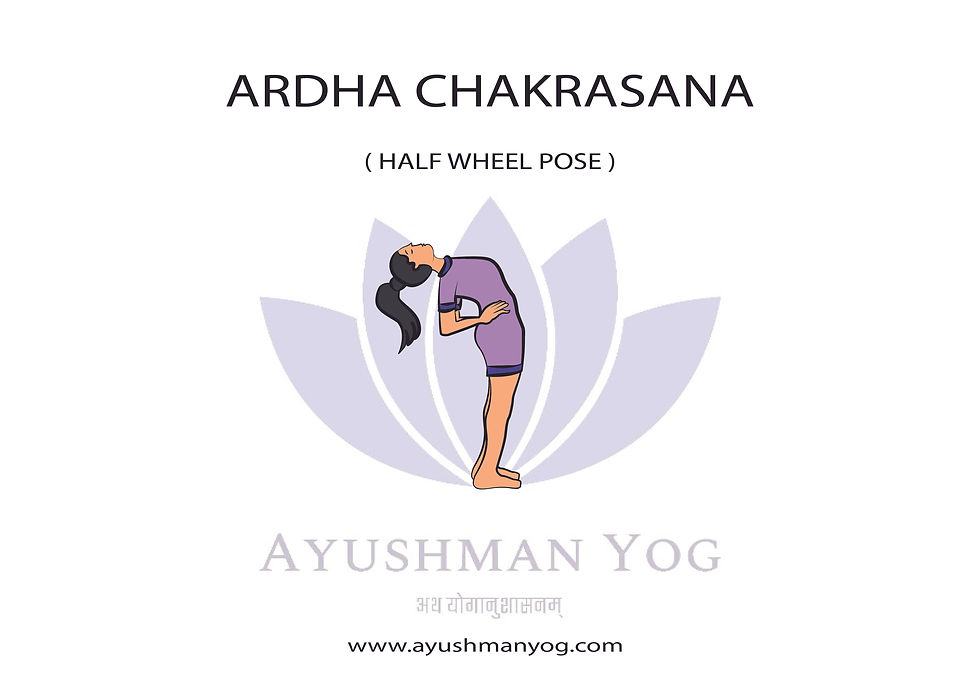
Standing poses build the structural foundation of a practice. They teach weight distribution, alignment, and the relationship between effort and ease. Begin with Tadasana, and understand it properly before moving to anything else. Tadasana is frequently dismissed as 'just standing,' but there are at least a dozen distinct alignment principles active in a well-executed Tadasana. Move on to Tiryak Tadasana, Kati Chakrasana, Ardha Chakrasana, Padahastasana, Trikonasana, and Parivritta Trikonasana. Back to Standing sthiti or sama sthiti.





4. Seated Asana (10-15 minutes)
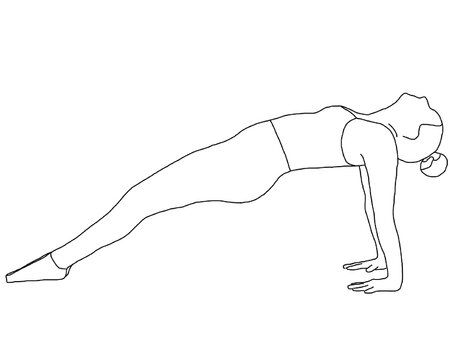
This is where most beginners spend most of their time. Include forward folds, gentle backbends, and at least one lateral stretch. The most commonly skipped category is spinal rotation, or twists. They are enormously beneficial for spinal health and digestive function, and almost always underrepresented in beginner sequences. Start with - Simple Dandasana, move on with Paschimottanasana, Purvottanasana, Bhu- naman asana, Vakrasana, Badhha Konasana- Dynamic flapping and Static fold, Naukasana, Upavishta Konasana (up to capacity), Balasana.




5. Preparatory Breathwork (5 minutes)
Breathing practices are consistently the most underemphasised element in beginner yoga teaching. Ensure that breathwork is an essential part of your routine. There are several breathworks and Pranayama technique, We are starting you of with a fundamental technique called as PRANA
PRANA (Progressive Respiratory Awareness & Nasal Adjustment).
Guidelines:
Sit in any comfortable posture, with the spine relaxed yet upright. Lying down is also acceptable if needed.
Put a timer for 5 minutes (For Week 1).
Inhale gently through the nose with minimal effort. The inhalation should feel natural, not forced or overly slow.
Exhale as slowly as possible through the nose, allowing the breath to lengthen naturally without strain.
Continue exhaling until you reach a natural endpoint, when no more air can be released comfortably. This is one breath.
Then inhale fully through the nose and begin the next slow exhalation.
Log the number of breaths taken per minute during each session for tracking progress.
Note:
Inhalations should remain smooth and effortless, not prolonged. As your practice develops, you’ll naturally find a comfortable rhythm for the inhalation.
The focus is on extending the exhalation and slowing the overall breath rate, not on timing each breath. Avoid counting seconds per exhale; instead, pay attention to the quality and depth of each exhale.
The goal is not to force a perfect breath count but to progressively lower your breathing rate through slow, effortless exhalation.
Sample Daily Log Sheet:
Date | Session Time | Breath Rate (BPM) | Nasal Breathing Success | Notes (Write your experience) |
Day 1 AM | 5 min | 10 BPM | Partial | Felt anxious, improved with focus |
Day 1 PM | 5 min | 9 BPM | Full | Relaxed after the session |
... | ... | ... | ... | ... |
Shavasana (5-10 minutes)
Savasana is the most important pose in any practice. It is the integration phase, where the neurological and physiological effects of the practice consolidate. Do not skip it because you do not have time or feel it is not 'doing anything.' It is doing more than most poses. Lie flat on your back, arms slightly away from the body, feet hip-width apart or slightly wider, eyes closed. Once settled, you can either-
Observe the belly movement with the breath,
Count the number of breaths,
Practice PRANA,
Chant Om or any other mantra for the duration of Shavasana,
Repeat affirmations
Stay for at least 5 minutes.
Common Mistakes Beginners Make-
Breathing in the wrong direction. Many beginners, when asked to inhale, lift their chest and pull their belly in. This is the opposite of correct diaphragmatic breathing. When you inhale, the belly should gently expand; when you exhale, it should fall.
Prioritising depth over correctness. A shallow, correctly aligned Padahastasana (standing forward fold) is more beneficial and far safer than a deep fold achieved by rounding the lumbar spine.
Holding the breath during effort. This is extremely common. Beginners often unconsciously hold their breath when a pose requires effort. The breath should remain continuous even in challenging moments.
Practising through sharp pain. Dull discomfort, the sensation of muscle lengthening under mild resistance, is normal. Sharp, acute, or joint pain is a signal to back off immediately. These two types of sensation are distinct, and beginners must learn to distinguish them.
Practising inconsistently and expecting dramatic results. Twenty minutes every day is vastly more effective than two hours once a week. Yoga adaptation is neurological; it happens through repetition and consistency, not through occasional intensity.
Should You Learn on Your Own or with a Teacher?
Both have merits. Learning from a qualified teacher, even online, provides feedback on alignment that self-practice cannot easily give. A teacher can see what you cannot see: the position of your pelvis in a forward fold, the collapse in your lower back in a seated pose, the asymmetry in your shoulder height.
If formal teacher training eventually interests you, or if you want to understand yoga with greater depth and structure, the online yoga certification courses at Ayushman Yog are structured specifically for this purpose, covering theory, philosophy, anatomy, and progressive practical training through live interactive classes.
For now, start where you are. Practise consistently. Observe what happens, not just in your body, but in your breath, your attention, and your mental state after each session. Those observations are where the actual practice begins.
For Some, This is Just the Beginning
Many yoga teachers did not begin with the intention of teaching. They began exactly where you are, with a mat, a quiet corner of their home, and a curiosity about what this practice could do. Over time, the practice deepened. The questions became more serious. The desire to understand yoga more fully, not just to do it, but to truly know it, became impossible to ignore.
If you find yourself moving in that direction, it is worth knowing that the path from home practitioner to qualified yoga teacher is far more accessible than most people assume. You do not need to travel to an ashram or take months off from your life. Ayushman Yog's Online Live Yoga Teacher Training courses are structured for exactly this transition, interactive, live classes conducted five days a week, covering asana, pranayama, anatomy, philosophy, and teaching methodology, all from home.
The practice you are building right now is not separate from that journey. It is the foundation of it.

Comments