
10 Basic Yoga Poses Every Beginner Must Know

Updated: May 10

Every yoga teacher, regardless of their lineage or style, returns to a core set of foundational asanas. Not because these poses are the easiest, but because they are the most instructive, they teach the body and nervous system the principles that underlie everything else. Across decades of teaching and thousands of students, certain postures appear again and again at the beginning of a practice, not by coincidence, but because they work.
What follows is not a list of the "simplest" poses. It is a list of the most important starting points, the ten asanas that, understood correctly, give a beginner everything they need to progress safely and meaningfully in any style of yoga.
Each pose is explained with what it is actually doing, how to do it with correct alignment, what most beginners get wrong, and why the pose matters beyond the physical.
Read information on Bhava : Concept of Bhava in Yoga Abhyas
Tadasana-

Technique:
Stand straight with your feet together and hands by your sides.
Inhale and raise both hands above your head. Interlock your fingers or join your hands in the prayer position.
Lift your heels and balance on your toes, keeping your gaze steady at eye level.
Stay in this position for 5-10 deep breaths.
Exhale and lower your hands and toes, bringing your hands slowly back to your sides.
Complementary Asana:
There is no specific complementary asana for Tadasana, but if the practitioner experiences dizziness, they should rest in Shavasana.
Bhava:
Gyana Bhava.
Benefits and Therapeutic Applications:
Enhances postural alignment by correcting misalignments like forward head, rounded shoulders, or lumbar lordosis, while promoting spinal elongation through axial extension and decompression.
Improves balance and proprioception while strengthening the lower body muscles such as thighs, knees, calves, and hips, thereby enhancing joint stability and supporting clients with balance disorders, neurological conditions, or age-related instability.
Beneficial for clients with anxiety, scattered focus, or sensory overload.
Regular practice during growth years may help with postural development and height potential.
Can be used safely with modifications for people recovering from mild lower back, knee, or postural issues.
Contraindications:
Vertigo, migraine, or dizziness.
Injury or weakness in the heels, knees, or calves.
Padahastasana-

Technique:
Stand straight with your feet together and arms by your sides.
Inhale and raise both arms overhead, then exhale as you bend forward, stretching your spine well.
Follow this alignment: bring your thighs parallel to your abdomen, knees parallel to your chest, and shins parallel to your chin.
The ideal position for your palms is on the floor beside your feet, though it is also acceptable to hold your heels from behind or grasp your toes.
Hold for 5-10 deep breaths.
In order to release, Inhale and extend your arms in front of you, keeping them parallel to the ground. This will help you get control of the back. Maintaining this control, trace your steps back to the starting position.
Complementary Asana:
Ardha Chakrasana, Hastottanasana, etc.
Bhava:
Vairagya Bhava.
Note:
Padahastasana is commonly taught using two distinct approaches. The following comparison highlights the differences in their mechanics and outcomes:
Hinge-and-Fold Approach:

Instruction: “Maintain a long spine and initiate the fold from the hips with a flat-back position. Keep the torso extended as you hinge forward, allowing the pelvis to tilt anteriorly. Gradually lower your body toward the legs, aiming to bring the abdomen toward the thighs and the chest toward the knees, if flexibility allows”.
Mechanics:
Minimal spinal flexion initially.
The pelvis goes into anterior tilt.
Hip flexion leads, while the spine maintains extension as long as possible to avoid early spinal rounding
A greater load is on the hamstrings and lumbar extensor control.
Outcome:
Avoids spinal rounding early.
Encourages posterior chain engagement (glutes, hamstrings, spinal extensors).
Often used to actively strengthen the lumbar region.
Sequential Approach:

Instruction: “Begin by allowing the head to drop gently. Let spinal flexion unfold progressively from the cervical spine, through the thoracic spine, and finally into the lumbar region. As the spine rounds naturally, allow the pelvis to follow with an anterior tilt, softening the fold gradually without force.”
Mechanics:
Cervical to thoracic to lumbar spinal flexion occurs progressively, with the pelvis simultaneously tilting anteriorly to support the depth of the fold.
Emphasis is on gentle flexibility, gentle fascial release, and calming of the nervous system through parasympathetic activation triggered by slow, mindful spinal flexion and head-down posture.”
Outcome:
Shoulders and thoracic spine round more.
May not deeply engage the lumbar or hips early.
Often used for therapeutic settings or to release back tension
Benefits and Therapeutic Applications:
Enhances spinal flexibility and strength through conscious flexion, promoting elongation and reducing compression. Encouraging passive traction for relief from mild mechanical back pain when performed mindfully with support.
Deeply stretches the hamstrings and mobilises the hip joints. Beneficial for individuals with sedentary lifestyles, elderly populations, or those recovering from restricted mobility. Always choose the approach as per the client's flexibility.
Engages and massages abdominal muscles and internal organs through compression, aiding digestion and improving gut motility.
Elongates tight kinetic chains from the feet to the back of the head, facilitating release in the calves, hamstrings, glutes, and spinal extensors.
Enhances proprioceptive feedback from the feet, hamstrings, and spine. Useful in retraining postural misalignments and improving movement pattern awareness.
Gentle practice enhances parasympathetic tone, calming the nervous system, reducing anxiety, and improving cerebral circulation. It promotes grounding, introspection, and emotional regulation, making it effective for anxiety and insomnia
Contraindications:
Slipped disc or any other type of chronic and clinical back pain, hernia, pregnancy, or any stomach surgery.
Parvatasana / Adho Mukha Svanasana -

Technique:
Begin in an all-fours position, ensuring your shoulders are stacked directly over your wrists and your hips are aligned over your knees.
On an exhale, press firmly through your palms and lift your hips up, coming into the pose.
Aim to keep your feet firmly grounded on the floor. If that isn't accessible yet, it is perfectly fine to stay on your toes as you build flexibility; simply keep pressing actively through the feet.
Continue pushing the floor away through your shoulders, while gently drawing your gaze toward your navel to lengthen the back of the neck.
Continue to breathe steadily, holding the pose for 5-10 deep, even breaths.
To release, slowly lower your knees back down to the floor with control.
Complementary Asana:
Bhujangasana, Shashankasana.
Bhava:
Vairagya Bhava.
Benefits and Therapeutic Applications:
Parvatasana actively lengthens the entire spine, relieving compression between the vertebrae. Hence helpful for those experiencing mild back stiffness or postural fatigue from prolonged sitting.
The pose builds strength in the shoulders, arms, and wrists while simultaneously engaging the core.
The mild inversion created by lifting the hips above the heart encourages blood flow to the brain, helping to reduce stress and mental fatigue.
Contraindications:
Shoulder injury, Wrist injury, Recent eye surgery, HBP.
Bhujangasana

Technique:
Lie down on your stomach.
Place your palms in line with your shoulders, keeping your elbows close to your body, and rest your forehead on the ground.
Inhale and lift your forehead, chest, and abdomen (only up to the navel) off the floor, ensuring that the elbows remain close to the body.
Hold for 5-10 deep breaths.
Exhale while slowly releasing the pose, rest in Makarasana.
Complementary Asana:
Parvatasana, Makarasana, Matsya Kreedasana.
Bhava:
Aishwarya Bhava.
Benefits and Therapeutic Applications:
The gentle extension of the spine stretches the thoracic and lumbar regions, reducing stiffness and promoting better posture and spinal support.
This also helps reduce nerve compression and may offer therapeutic relief from sciatica symptoms when done with caution.
The expansion of the chest stretches the pectoral muscles and counteracts rounded shoulders, while encouraging deeper inhalation and enhancing respiratory function and lung capacity.
The mild compression of the abdomen can help stimulate peristalsis and support digestive function,
The pressure on the pelvis promotes reproductive health.
The mild backbend can help reduce fatigue and promote a sense of lightness and vitality when practised mindfully.
Contraindications:
Carpal tunnel syndrome, recent abdominal surgery, and pregnancy.
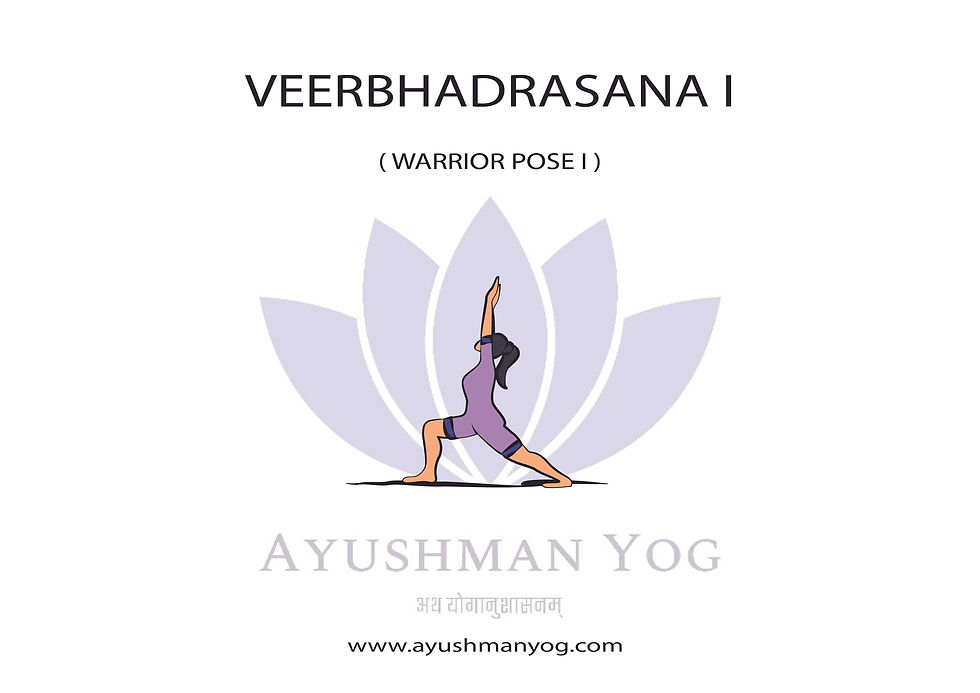
5. Veerbhadrasana 1
Technique:
Stand straight, placing your right foot forward and left foot back. Ensure that your right foot is aligned with the long side of the mat and your left foot is aligned with the short side of the mat.
Bend the front knee to about 90 degrees, and keep the back leg straight and strong.
Twist the torso towards the front leg, and raise both arms overhead. Palms can be kept in the namaste mudra.
Gaze forward, or slightly upwards, depending on neck comfort. Take deep, steady breaths, inhaling to elongate the spine, exhaling to deepen the bend in the front knee.
Hold for 5-10 deep breaths and repeat on the other side.
Complementary Asana:
Self-complementary.
Bhava:
Aishwarya Bhava.
Benefits and Therapeutic Applications:
Veerbhadrasana 1 builds strength in the quadriceps, glutes, and calves while deeply stretching the hip flexors and chest. It is therapeutic for those with tight hips or rounded shoulders from sedentary lifestyles.
The pose powerfully improves balance and stability, training the body to root down through the feet while simultaneously lengthening upward through the spine.
Activates the sympathetic and parasympathetic nervous systems in balance, building focus and mental resilience, making it valuable for those dealing with low energy, lack of confidence, or emotional fatigue.
Contraindications:
Chronic Knee pain, Frozen shoulder, Hip injury.
6. Veerbhadrasana 2

Technique:
From Virabhadrasana I, open the hips and shoulders to face the side. The right knee stays bent at 90 degrees, and the back leg remains straight as earlier.
Extend the arms sideways as shown in the image, palms facing down, and keep the chest open.
Inhale, and turn your neck towards the right fingers.
Hold for 5-10 deep breaths and repeat on the other side.
Complementary Asana:
Self-complementary.
Bhava:
Aishwarya Bhava.
Benefits and Therapeutic Applications:
Like Warrior I, Warrior II also strengthens the legs and improves lower body endurance, but places a greater emphasis on opening the hips and inner thighs, making it helpful for those with tight groins or hip stiffness.
Building on the stability of Warrior I, Warrior II further develops lateral awareness and full-body coordination, training the body to expand outward in opposite directions simultaneously, making it deeply beneficial for spinal alignment and shoulder mobility.
Contraindications:
Chronic Knee pain, Frozen shoulder, Hip injury.
Shashankasana

Technique:
Start by sitting in Vajrasana with toes together, heels apart, and the spine straight.
Inhale, raise the arms above your head while keeping the spine upright.
Exhale, bend forward while extending the arms overhead to the floor.
Complementary Asana:
This is a relaxation posture in itself, so it generally doesn't require a complementary pose..
Bhava:
Vairagya Bhava.
Benefits and Therapeutic Applications:
Encourages gentle flexion of the spine, helping to relieve lumbar tension and decompress intervertebral discs, promoting spinal mobility and relaxation.
Promotes scapular protraction as the arms extend forward, helping to release tension in the upper back, neck, and shoulders.
Modifying the pose (such as keeping the knees apart) provides lumbar relief during pregnancy and can support pelvic floor relaxation and recovery after childbirth.
Activates the parasympathetic nervous system via gentle forward bending and deep breathing, encouraging calmness, reduced stress, and mindful grounding.
Contraindications:
Knee pain, neck, or shoulder injury.
Paschimottanasana-

Technique:
Sit with your leg stretched on the floor.
Inhale and raise both arms overhead.
Exhale and bend forward while keeping the back straight, attempting to hold the toes with the hands.
The alignment should be as follows: abdomen over thighs, chest over knees, chin over shins.
Hold for 5-10 deep breaths.
Inhale and return to the starting position.
Complementary Asana:
Purvottanasana
Bhava:
Vairagya Bhava.
Benefits and Therapeutic Applications:
Deep forward bend stretches and elongates the spinal column, promoting healthy posture and reducing lower back stiffness.
Stretches the lower body, including hips, hamstrings, and calves.
Activates the liver, kidneys, ovaries, and uterus, improving digestion, appetite, and hormonal balance.
Calms the nervous system, reducing anxiety, fatigue, and stress-related tension through deep exhalation and inward focus.
Contraindications:
Slipped disc, cervical spondylitis, recent abdominal surgery, hernia, pregnancy.
Vajrasana-

Technique:
Stand on your knees and then lower your body in such a way that your hips rest on your heels and your thighs rest on your calves.
Keep both big toes together and the heels slightly apart.
Keep your back straight, and place your palms on your knees.
Hold for 5-10 deep breaths.
Complementary Asana:
Dandasana or Shithil Dandasana.
Bhava:
Dharma Bhava.
Benefits and Therapeutic Applications:
The steady, grounded posture activates the parasympathetic nervous system to reduce stress and anxiety, while strengthening the lower body to provide a stable foundation for meditation and pranayama.
By compressing the lower GI tract, it supports digestion, relieves bloating, and improves metabolism, ideal for practice after meals.
Promotes awareness and strength of pelvic muscles, helpful in managing incontinence and reproductive health in both men and women.
Encourages venous return from the legs, supporting varicose vein prevention and leg fatigue relief.
Contraindications:
Knee arthritis, slipped disc, ankle pain, etc.
Makarasana-

Technique:
Lie down on your stomach.
Place your hands on top of each other and rest your chin, cheek, or forehead on your palms.
Keep your toes pointing outward and maintain normal breathing, as shown in image: Makarasana -1.
Alternatively, you can join the toes together and heels apart, as shown in image: Makarasana -2.
An alternate arm position is to cross the forearms in front of the chest so that each palm rests on the opposite shoulder, with the elbows comfortably supported on the floor.
Another arm position can be to let the elbows rest on the floor while the palms are placed beneath the cheeks for support.
Practitioners may adjust and combine arm and foot positions according to what feels most relaxed and comfortable for their body.
Makarasana is usually practised as a relaxation posture like Shavasana.

Complementary Asana:
Generally, no specific complementary asana is required. However, Balasana or Shavasana can be practised for further relaxation.
Bhava:
Vairagya Bhava.
Benefits and Therapeutic Applications:
Passive prone positioning relaxes the paraspinal muscles, easing nerve root compression in sciatica and disc herniation.
Encourages vagal tone, calming the nervous system, useful in reducing anxiety, insomnia, and hypertension.
Acts as a restorative reset for breath awareness and nervous system balance, allowing stillness and internalisation before or after active yoga practices.
Contraindications:
Recent abdominal surgery, ulcers, hernia, pregnancy.
A Note on Sequencing
These ten poses are not meant to be practised in isolation or in this exact order every time. They are a vocabulary. Like words in a language, their meaning and effect change depending on what comes before and after them. A yoga teacher understands how to sequence them, how to open the hips before demanding hip-open standing poses, how to counterpose backbends with forward folds, and how to gradually build heat and then release it.
Want to go deeper into each of these poses? Explore our Asana Library: A Complete Visual Guide to Yoga Poses, where every posture comes with step-by-step instructions, alignment cues, benefits, and reference photos, a resource you can return to again and again as your practice grows.
And if understanding sequencing, alignment, and the full range of yoga teaching skills interests you, Ayushman Yog's YCB Level 1 Yoga Teacher Training covers all of this in a structured, government-recognised format, through live, interactive online classes with qualified and experienced teachers.

Comments