
Dhirendra Brahmachari on Sheershasana: The King of All Asana


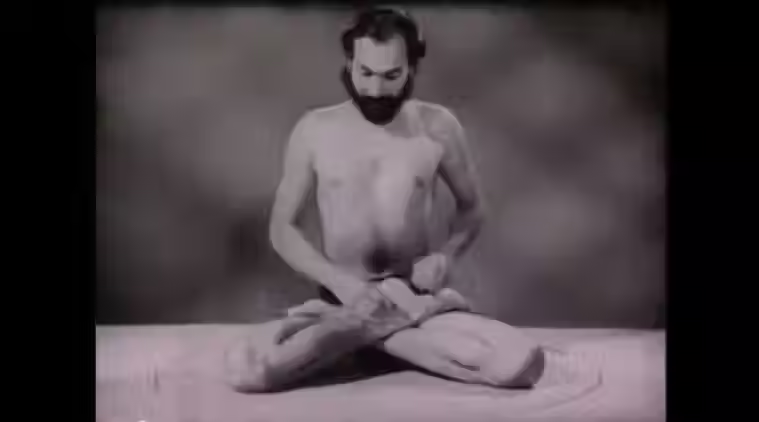
Within the vast and diverse world of yogic practice, few teachers have approached a single asana with the depth, precision, and philosophical seriousness that Dhirendra Brahmachari brought to Sheershasana. A direct disciple of Swami Karttikeya Ji Maharaj of the Himalayas, Brahmachari did not merely teach Sheershasana as a posture to be performed. He approached it as a complete science in itself, one that demanded anatomical understanding, energetic awareness, correct technical execution, and a deep respect for the intelligence of the human body.
In his own words, "just as the lion is the king of all animals in the forest, Sheershasana is the king of all yogic asanas. Among all the asanas of the yogic tradition, whatever benefits any single asana provides, all of those benefits reside within Sheershasana alone."
It is a statement not of exaggeration but of deep experiential conviction, arrived at through decades of personal practice, teaching, and direct observation.
This blog draws entirely from Brahmachari's own documented teaching to present his understanding of Sheershasana as he himself articulated it.
The Question of Correct Practice:
One of the most important and distinctive aspects of Brahmachari's teaching on Sheershasana is his insistence that incorrect practice is not merely ineffective but actively harmful. He observed in his own experience as a teacher that many practitioners were performing Sheershasana incorrectly, placing weight on the wrong part of the head, and as a consequence experiencing a range of difficulties, including hair fall, weakening of eyesight, heaviness in the head, and mental disturbances.
He further observed that when these same practitioners were taught to perform Sheershasana correctly, on the right point of the head, with the right support and the right approach, their difficulties resolved, and they became sincere advocates of the practice.
This is a significant teaching. It tells us that the power of Sheershasana is real and substantial, but that this power is entirely contingent on the correctness of execution. Brahmachari's contribution here is not merely technical instruction but a clear articulation of the relationship between anatomical precision and energetic outcome in yogic practice.
The Three Parts of the Head: A Teaching of Remarkable Precision
Central to Brahmachari's teaching on Sheershasana is his identification and detailed explanation of three distinct parts of the head, each with a different anatomical and energetic significance, and each calling for a different relationship with the ground in Sheershasana.
The first part: the correct point of contact
The first part is the area of the head located just above the forehead, at the point where the hairline begins. Brahmachari described this with great precision: approximately four fingers measured from the hairline, of which two fingers fall below a central point and two fingers above it, constitute the ideal zone of contact for Sheershasana. He recommended preparing a small round cushion from a folded cloth, in the manner that rural Indian mothers prepare a ring of cloth to balance a vessel on their head, and placing this precise area of the head onto that cushion as the foundation of the posture. He stated clearly that when Sheershasana is performed with this part of the head as the base, no harm occurs and all the benefits of the practice are fully obtained.

The second part: Brahmarandhra, the seat of prana
The second part is the area located at the top of the skull that remains soft and open in newborn infants. In yogic tradition, this is known as Brahmarandhra, the gateway through which prana enters and exits the body, and the point at which advanced yogis in the states of samadhi and turiya are said to be established. In the Yogic Sukshma Vyayama, this very point is referred to as the Smaran Shakti Vikasak, the centre associated with the development of memory and higher cognitive function. Brahmachari was unequivocal in his instruction regarding this area: placing weight on Brahmarandhra in Sheershasana causes various diseases, and this area must never under any circumstances be used as the base of the posture. The energetic and physiological sensitivity of this region demands that it be protected, not loaded.

The third part: the Shikha Sthan
The third part is the area at the crown and back of the head known as the Shikha Sthan, the place where traditionally a shikha or choti is kept, and a point considered sacred in Indian tradition. Brahmachari noted that using this area as the base of Sheershasana yields neither benefit nor harm. It is simply not the correct point of contact for the practice, and placing the posture there produces no meaningful result in either direction.

This three-part framework is a teaching of extraordinary anatomical and energetic precision. It reflects Brahmachari's understanding of the human head not merely as a physical structure but as a terrain of differentiated energetic significance, each part with its own function, its own vulnerability, and its own relationship to the practice of inversion.
The Role of the Hands and the Preparation of the Base
Alongside his teaching on the three parts of the head, Brahmachari also provided detailed instruction on the role of the hands and forearms in establishing the base of Sheershasana. He described how the interlocked fingers and forearms form a stable triangular foundation together with the head, and how the weight must be distributed correctly across this triangle rather than concentrated exclusively on the crown of the head. He noted that the cloth cushion placed beneath the head should be positioned on the hands and forearms, and that the practitioner should enter the posture by carefully placing the correct point of the head onto this prepared base before raising the legs.
He also emphasised that Sheershasana, when performed correctly, produces a perfectly straight vertical alignment from the head through the entire body to the feet, as can be seen clearly in his own photographs demonstrating the posture. This vertical alignment is not merely aesthetic but functional, reflecting the correct distribution of weight and the proper channelling of prana through the central axis of the body.
Sheershasana as a Complete Practice: The Variations
One of the most remarkable aspects of Brahmachari's documentation of Sheershasana is the breadth of variations he recorded, demonstrating that he understood Sheershasana not as a single static posture but as a complete and expansive system of practice. Each variation builds upon the foundational posture and develops different dimensions of strength, balance, flexibility, and body awareness. The variations he documented include the following:
The images below are sourced from Dhirendra Brahmachari's original manuscript. Where the original photographs appear unclear, our character Veda illustrates the variation for better understanding.
The foundational Sheershasana with both legs together and perfectly straight, the body in complete vertical alignment from head to toe, which he photographed and described as the correct and fully realised expression of the posture.

A variation in which one leg is held straight upward while the other is bent at the knee in a manner resembling Vrksasana, with the two legs alternating, developing unilateral balance and independent leg control within the inverted position.

A variation in which one leg is extended straight while the other is bent with the foot resting near the knee of the straight leg, again performed alternately on both sides, developing a different quality of hip and knee control.


A variation in which the body from head to waist is kept perfectly straight and vertical while both legs are extended outward horizontally, the body held in a precise right angle, requiring exceptional core and hip flexor strength. In the same stance, he further suggest to move the legs in multiple directions, such as forward and backwards, side to side, and diagonally, exploring the full range of hip mobility within the inverted position.


A variation in which both legs are folded into Padmasana, while in the full inversion, the body is held perfectly straight and vertical with the legs crossed and the feet resting on the thighs, combining the qualities of Padmasana with the inversion of Sheershasana.


An exit variation in which the practitioner descends from the full posture by drawing both knees toward the chest while the body folds forward, a controlled and conscious return to the ground that itself requires significant body awareness and strength.

Together, these variations reveal a practitioner and teacher who had explored Sheershasana with extraordinary thoroughness, understanding it as a practice with an internal developmental arc from the foundational to the advanced, from the simple to the complex, from the gross to the subtle.
Dhirendra Brahmachari's Philosophical Dimension: Sheershasana and the Subtle Body
Beyond the anatomical precision of his teaching, Brahmachari's understanding of Sheershasana was rooted in a philosophical framework drawn from classical yogic tradition. His identification of Brahmarandhra as a site requiring protection in Sheershasana was not merely a matter of physiological caution. It reflected a deep understanding of the subtle body, of the relationship between the physical structure of the head and the energetic realities it houses.
The Brahmarandhra in yogic philosophy is the point of the highest energetic significance in the human body, the place of the Sahasrara, the point where the individual consciousness interfaces with the universal. To place weight and pressure on this point carelessly and without awareness is, in Brahmachari's understanding, to disturb the very centre of the practitioner's energetic and cognitive life. The Smaran Shakti Vikasak designation given to this point in the Yogic Sukshma Vyayama tradition further underscores its association with memory, clarity, and higher mental function.
Conversely, the correct point of contact for Sheershasana, the four-finger zone above the hairline, allows the practitioner to receive the full benefits of the inverted position while leaving the Brahmarandhra free, undisturbed, and in its natural state. This is the integration of gross anatomical understanding and subtle energetic wisdom that characterises Brahmachari's teaching at its finest.
A Note on Duration and Approach
Brahmachari also offered practical guidance on the duration of Sheershasana practice. He noted that for householders whose diet may not be fully sattvic, Sheershasana should not be held for more than ten minutes. For those with a disciplined, sattvic diet and a regular practice of brahmacharya, longer durations become progressively accessible. He cautioned against using walls or external supports to hold Sheershasana beyond one's actual capacity, noting that this leads to harm rather than benefit. One should practice Sheershasana only for as long as one can comfortably sustain it through one's own strength and stability. The posture, he said, should always be followed by a period of rest in Shavasana of approximately half the duration of the Sheershasana itself, and thereafter a gentle self-massage of the head and body in a standing position.
The Significance of This Teaching Today
Dhirendra Brahmachari's teaching on Sheershasana stands as one of the most precise, complete, and philosophically grounded treatments of a single asana in the modern yogic literature. It bridges the gross and the subtle, the anatomical and the energetic, the practical and the philosophical. It demonstrates what is possible when a teacher of deep classical training brings the full weight of experiential knowledge to bear on even a single element of practice.
For the modern yoga student and teacher, this teaching offers several important insights. It reminds us that precision in practice is not pedantry but respect; respect for the intelligence of the body, for the depth of the tradition, and for the well-being of the practitioner. It reminds us that yogic knowledge at its highest is always simultaneously gross and subtle, simultaneously practical and philosophical. And it reminds us that a truly great teacher is not one who simplifies, but one who illuminates.
Shirshasana in the YCB Examination Framework
Dhirendra Brahmachari's detailed and precise approach to Shirshasana has been formally recognised within India's structured yoga education system. The Yoga Certification Board (YCB) includes various Shirshasana variations in the practical examination components of its higher certification levels, specifically Level 6 and Level 7, reflecting the technical depth and classical grounding that this asana requires at an advanced stage of practice.
Practitioners and aspiring yoga therapists appearing for these levels are assessed not simply on performing the posture, but on the kind of anatomical and energetic precision that Brahmachari documented throughout his teaching life.
YCB Level 6 - Program- Click here to explore the YCB Level 6 Program
To study Brahmachari's system directly from the source, download his original manuscript. Download the Original Manuscript-


Comments