
Dhirendra Brahmachari: The Yoga Master Who Taught India to Move with Breath

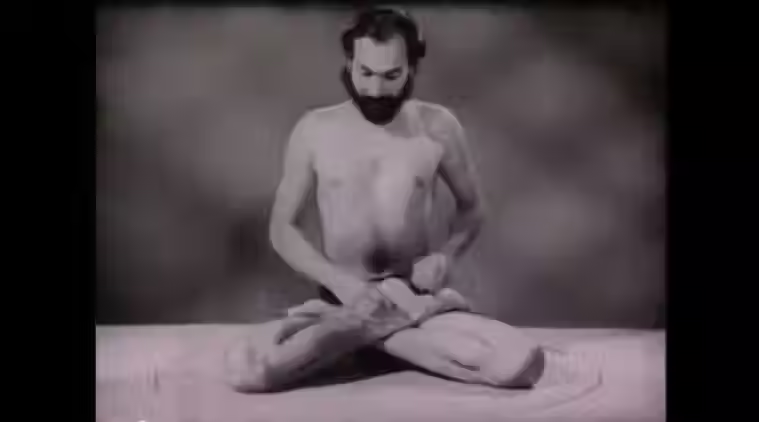
When we think of yoga today, most of us picture slow stretches, long holds, and meditative flows. But one of India's greatest yoga masters of the 20th century had a very different vision; one that was dynamic, precise, breath-driven, and remarkably complete as a fitness system.
Dhirendra Brahmachari, a direct disciple of Swami Karttikeya Ji Maharaj of the Himalayas, brought to the world a methodology rooted in deep classical knowledge; one that remains as relevant and powerful today as it was when he first introduced it to Indian households through national television.
Dhirendra Brahmachari's Approach: A Methodology Unlike Any Other
What set Dhirendra Brahmachari apart was not just what he taught, but how he taught it. His approach was built on fast, rhythmic movements performed with absolute breath control. On the surface, the practices may appear simple. But when done the way he intended, with precise coordination of breath and movement, they become extraordinarily powerful.
This approach is unique because it works on all five parameters of physical fitness simultaneously:
Cardiovascular health: The rhythmic pace elevates heart rate and improves circulation
Muscular stamina: Repeated dynamic movements build endurance over time
Muscular strength: Controlled fast movements engage deep muscle groups
Body balance: The coordination required trains neuromuscular balance
Flexibility: Consistent practice gradually opens joints and lengthens muscles
Most fitness systems address one or two of these. His system addresses all five in a single session, without any equipment, gym membership, or hours of free time.

Yogic Sukshma Vyayama: A Complete System of Movement
One of Dhirendra Brahmachari's most significant contributions to the world of yoga and wellness is the tradition of Yogic Sukshma Vyayama, a complete and structured system of movement comprising two distinct categories: Sukshma Vyayama and Sthula Vyayama. Together they form a practice that addresses the human body from its most subtle to its most gross level, leaving nothing unattended.
Sukshma Vyayama: 48 Subtle Isolated Movements
Within the tradition of Yogic Sukshma Vyayama, the Sukshma Vyayama component consists of 48 subtle exercises that work on the body at its most fundamental level. The word "sukshma" means subtle or micro, and the philosophy behind this system is simple yet profound: health begins at the most subtle level of the body. Each of the 48 movements is essentially an isolated movement, meaning predominantly one joint is mobilised at a time. Fingers, wrists, ankles, shoulders, neck, eyes, and even facial muscles are each addressed individually and with complete attention.
This isolation principle ensures that no joint, no energy channel, and no part of the body is left unattended. When practised with breath awareness at the pace Brahmachari intended, these seemingly minor movements produce a profound cumulative effect on joint health, nervous system function, and overall vitality, effects that no conventional workout can replicate.
Sthula Vyayama: 5 Compound Movements That Build the Whole Body
Complementing the subtlety of Sukshma Vyayama is the Sthula Vyayama component, a set of 5 gross or compound movements where more than one joint is engaged simultaneously.
Practices like Hrid Gati and Sarvanga Pushti are prime examples of this; multiple joints, muscle groups, and organ systems working in full coordination, producing a powerful, integrative, full-body effect. Sthula Vyayama builds strength, stamina, and gross physical capacity.
Together, the two systems create something complete; a practice that addresses the human body from its most subtle to its most gross level, leaving nothing out.

Beyond Yogic Sukshma Vyayama: His Approach to Surya Namaskar
Alongside his seminal work on Yogic Sukshma Vyayama, Dhirendra Brahmachari also brought a distinctive approach to Surya Namaskar that is worth understanding in its own right.
His sequence includes postures not commonly found in other versions, such as Ardha Chandrasana and Chaturanga (which also differs in form from the Chaturanga of the Ashtanga tradition of Pattabhi Jois), giving it a unique character in terms of both its structural composition and its physical demand.
Different traditions have approached Surya Namaskar with different intentions, some emphasising slow, meditative flow and inward awareness, others emphasising rhythmic dynamism and breath-driven movement. Brahmachari's approach belongs firmly to the latter; a fast-paced, breath-coordinated practice that develops cardiovascular endurance, muscular strength, and flexibility simultaneously. Note that neither approach is superior to the other; they serve different purposes and suit different practitioners and contexts. What makes Brahmachari's version particularly noteworthy is how completely it integrates the five parameters of physical fitness into a single, accessible daily practice.
Shirshasana: His Teaching on the King of All Asanas
Dhirendra Brahmachari held Shirshasana in the highest regard within the entire canon of yogic practice. In his own words, just as the lion is considered the king of all animals, Sirsasana is the king of all yogic asanas. He wrote that among the 84 lakh asanas, whatever benefits any asana provides, all of those benefits exist within Shirshasana alone.
One of his most precise and important technical contributions was his detailed instruction on exactly which part of the head should form the base of Shirshasana; a detail he considered critical to both the safety and the effectiveness of the practice. He identified three distinct parts of the head in this context:
The first and correct point of contact is the area just above the forehead where the hairline begins. Approximately four fingers measured from this point, two fingers below and two fingers above, form the ideal base for Shirshasana. He recommended placing a small folded cloth or cushion at this precise point, similar to how rural mothers roll a cloth ring to balance a vessel on their head, and placing this point on the cushion as the foundation of the posture.
The second part he identified is the area that remains soft in infants, known in yogic tradition as Brahmarandhra, the seat of prana, the point where advanced yogis are said to attain samadhi, and what the Yogic Sukshma Vyayama tradition refers to as the Smaran Shakti Vikasak point. He explicitly cautioned that using this area as the base of Shirshasana causes various diseases, and under no circumstances should weight be placed here.
The third part is the Shikha Sthan, the area at the crown and back of the head where a traditional shikha or choti is kept, a point considered sacred in Indian tradition. He similarly cautioned that placing the base of Shirshasana here yields neither benefit nor harm, and that this point is also not the correct foundation for the practice.
This level of anatomical and energetic precision in his teaching of a single asana reflects the depth and care that characterised Dhirendra Brahmachari's entire approach to yogic practice.

How He Brought Yoga to the People
Dhirendra Brahmachari was among the first yoga teachers to use Indian national television to reach the masses, at a time when yoga was still considered esoteric, inaccessible, or confined to ashrams and forest hermitages. His televised classes reached millions of households and played a significant role in demystifying yoga for general understanding.
He also established the Vishwayatan Yogashram in Delhi, and his influence extended into schools and institutions across the country. His proximity to the political leadership of the era gave him a platform, and he used it deliberately to push for yoga's integration into mainstream education and public health.
Why His Work Matters More Than Ever Today
Dhirendra Brahmachari's system of Yogic Sukshma Vyayama stands as a timeless and complete contribution to the science of yoga and human wellbeing. What makes it enduringly relevant is its remarkable wholeness, a practice that requires no equipment, no special setting, and no prior athletic ability, yet works simultaneously on all five parameters of physical fitness: cardiovascular health, muscular stamina, muscular strength, body balance, and flexibility.
The intelligence of this system lies in its design, rooted in classical yogic understanding of the human body, passed down through the Himalayan tradition of Swami Karttikeya Ji Maharaj, and made accessible to every sincere practitioner through the life's work of Dhirendra Brahmachari.
A dedicated practice of Sukshma and Sthula Vyayama, done with proper breath control and the right intention, can genuinely transform one's physical and energetic wellbeing, regardless of age or current fitness level. It is a system that does not compete with other approaches to health and movement; it simply stands on its own, complete as it is.
Recognition Within the YCB Examination Framework
A particularly significant acknowledgement of Dhirendra Brahmachari's contribution to modern yoga education is the inclusion of several Sukshma Vyayama and Sthula Vyayama practices from the Yogic Sukshma Vyayama tradition in the practical examination component across all YCB levels. This means that students appearing for government-recognised YCB certification examinations are assessed on practices that originate directly from Brahmachari's system, underscoring the academic and practical legitimacy that this tradition has earned within India's most structured yoga certification framework.
At higher levels of YCB certification, specifically Level 6 and Level 7, Dhirendra Brahmachari's distinctive variation of Surya Namaskar is also included in the practical curriculum, further reflecting the depth and relevance of his contribution across the full spectrum of yoga professional training.
For those interested in pursuing YCB certification and studying these practices in a structured, holistic, and academically rigorous environment, we invite you to explore our courses at Ayushman Yog.
Download our course brochure to learn more about our YCB programmes, curriculum, and certification process.
We also offer a self-paced video course on Sukshma Vyayama that introduces you to this remarkable practice step by step, with guidance on breath coordination and movement quality.


Comments