
Dhirendra Brahmachari's Surya Namaskar: A Rare Documentation of a Living Tradition


Where Is Surya Namaskar in the Classical Texts?
If you search for Surya Namaskar in the Hatha Yoga Pradipika, you will not find it. Look through the Gheranda Samhita, the Shiva Samhita, the foundational texts of the Hatha tradition, and it is absent there too. For a practice that is today performed by millions of people every morning, in yoga studios and school grounds and living rooms across the world, this absence is quietly remarkable.
Surya Namaskar was never written down in the classical period. It was lived. It passed from teacher to student through direct transmission, through demonstration, correction, repetition, and the accumulated embodied knowledge of the guru-shishya parampara. For centuries, this was enough. The practice did not need a text because it had something more reliable: a living lineage.
It was only in the twentieth century that the need to document this transmission began to be felt, as yoga travelled beyond the ashram, as students multiplied, and as the possibility of a practice being lost or diluted without a written record became a real concern. And it is telling that when documentation happened, it happened independently, across multiple lineages, by multiple great teachers, each recording what they had received and practised. The versions that emerged were not identical. They could not be, because what each teacher recorded was their own direct experience of a practice that had never been fixed in writing. Each version is therefore a window not just into Surya Namaskar, but into the mind and body and pedagogical intent of the teacher who recorded it.
The commonly known Surya Namaskar, the twelve-step sequence most practitioners encounter in their training, was documented and systematised by the Bihar School of Yoga with great care and clarity. What makes this documentation particularly valuable is its progressive pedagogical structure: the practice is not simply performed but learned in layers. A student first masters the physical movements, then integrates breath awareness, then introduces the solar mantras, and finally the beeja mantras, each layer deepening the practice until movement, breath, and awareness become genuinely integrated. The Bihar School of Yoga's work in bringing this structured, layered approach to generations of practitioners has been significant and far-reaching.
Around the same period, T. Krishnamacharya, one of the most significant figures in the modern transmission of Hatha yoga was teaching his own approach to dynamic, flowing practice in Chennai. His student Pattabhi Jois would go on to develop Sun Salutation A and Sun Salutation B as the opening foundation of the Ashtanga Vinyasa series. The vigorous, strength-demanding, dynamically sequenced character of those salutations, even though different from the traditionally practised classical version, bears striking structural similarities to another documentation happening in the same era, in a different lineage entirely.
Dhirendra Brahmachari, a direct disciple of Swami Karttikeya Ji Maharaj of the Himalayas, recorded his version of Surya Namaskar in what is believed to be Yogasana Vigyan. Whether these parallel developments influenced one another or simply reflect the same fertile living tradition expressing itself through multiple great practitioners simultaneously, we cannot say with certainty. What we can say is that the resemblance is not accidental. The tradition was alive, and its vitality was showing up across lineages in the same historical moment.
This blog is about Brahmachari's version, the one that remains largely unknown, rarely discussed, and almost never taught outside those who have studied his work directly.
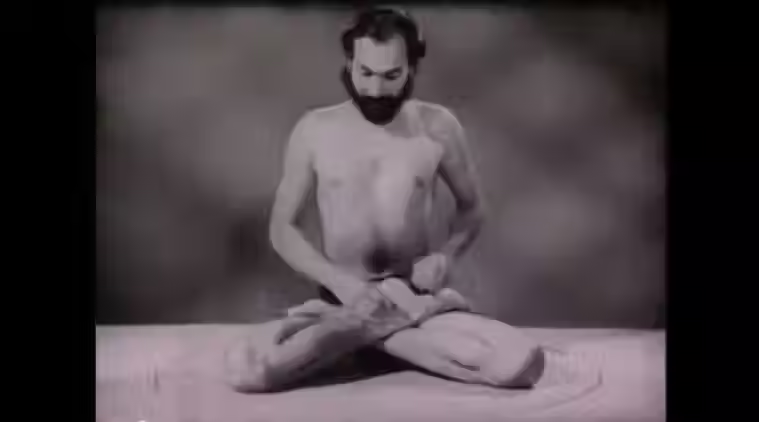
We are presenting it here as a rare documentation of a living tradition, using his original photographs alongside Veda's (Ayushman Yog's illustration guide) illustrations for clarity. We assume you are already familiar with the commonly known Surya Namaskar. What follows is an attempt to show you something you have very likely never seen before.
Step 1-The Opening: Same Posture, Different Preparation


Both sequences begin in the same essential standing posture, feet together, palms joined at the chest, the body gathered and inward. In the commonly known version, this opening is Pranamasana. The practitioner arrives in stillness, and from that stillness, the first solar mantra, Om Mitraye Namah, prostration to the one who is affectionate to all, is chanted, orienting the awareness toward Lord Surya as the primordial source of energy and life. Movement, breath, and inner awareness begin to converge from the very first position.
Brahmachari's opening position is Namaskarasana (No difference in the meaning of the name), the same gesture of collected stillness. His instruction is characteristically direct: stand, keeping feet together, palms joined at the chest, maintain a firm and steady posture, and bring focus inward. The awareness is present from the first moment, held within the body rather than oriented outward through mantra.
Step 2-Hastottanasana: The Arch Deepens


Both sequences raise the arms overhead into Hastottanasana as the second position. In the commonly known version, the backward arch originates primarily from the lumbar region, the neck follows the natural curve of the spine, and the upper arms remain close to the ears, a considered, anatomically mindful extension.
Brahmachari's instruction for this position sets the tone for everything that follows: the lower body is held completely rigid, and the upper back arches as far back as possible with a deliberate, fast flow; arms are kept straight and close to the ears. The deliberate rigidity of the lower body, while the upper back extends to its maximum, creates a more concentrated and demanding spinal work than the classical version. It may look like the same posture as the classical version, but it is approached with a different internal instruction of fast pace, and that internal instruction changes the intensity, energy expenditure, and the effect entirely.
Step 3- Padahastasana: A Higher Bar


Padahastasana, the standing forward fold, is familiar to every practitioner. In the classical version, the ideal alignment is stomach on thighs, chest on knees, and chin on shin. This is also approached progressively.
Brahmachari's version of this transition is immediately more demanding in two ways. First, the arms swing forward and downward with momentum; the transition is not a careful hinge but a deliberate forward swing. Second, the forehead to knees, without bending the knees. The hamstrings, the lower back, and the practitioner's willingness to meet the posture fully are all called upon at once. This momentum-into-precision approach appears again and again throughout his sequence.
Step 4- Ashwa Sanchalanasana: The Jerk That Changes Everything


This is where a practitioner familiar only with the classical sequence will begin to feel genuinely different ground beneath their feet.
In the classical version, Ashwa Sanchalanasana, the equestrian pose is performed by stepping the right leg back with care and placement. The right thigh moves toward the floor, the left knee stacks above the left ankle, the spine lengthens, and the gaze lifts. It has the quality of a deep, grounded opening, a lunge that asks the body to release and extend.
Brahmachari's Ashwa Sanchalanasana follows the momentum approach again: the right leg is taken back with a jerk. Not a step; a spring-like, forceful, dynamic movement. The back knee does not touch the floor. Balance is maintained on the toes of the back foot. The front knee also bends beyond the toes, the hips are completely down, the chest lifts, and the gaze moves upward.
The instruction to use a jerk is not a casual detail. It actually is a deliberate pedagogical choice that runs through multiple transitions in this sequence. Brahmachari understood vigour and momentum as legitimate and valuable tools of physical preparation, not as a departure from yogic practice, but as an expression of it. For the practitioner trained only in flowing, controlled transitions, this is an invitation to meet the practice on different terms.
Step 5- Ardha Chandrasana: The Posture Nobody Expected


What comes next will surprise every practitioner who knows only the classical version of Surya Namaskar, because it does not exist there at all.
From the Ashwa Sanchalanasana position, Brahmachari instructs the practitioner to raise both arms overhead and arch backwards from the waist. The hips dip even more, the chest opens and lifts fully, and balance is held on the toes throughout. This is Ardha Chandrasana, a deep half-moon backbend performed from a single-leg lunge balance on the toes of the back foot.
The insertion of this posture is one of the most revealing moments in Brahmachari's entire sequence. It shows a teacher who was not simply rearranging familiar components but thinking architecturally about what the body needs at each stage, adding a dimension of spinal extension and balance challenge.
Steps 6 and 7: Bilateral Symmetry Within One Round
After completing Ashwa Sanchalanasana and Ardha Chandrasana on the left leg, Brahmachari's sequence does something structurally elegant that sets it apart from the classical version.
In the classical version, symmetry across the body is achieved over two full rounds of twelve steps; the right leg goes back in the first round, the left leg goes back in the second. A complete bilateral practice, therefore, requires twenty-four positions across two rounds.
Brahmachari's sequence achieves bilateral symmetry within a single round of twelve positions. Steps 6 and 7 mirror steps 4 and 5 immediately: the arms come down, the legs switch with a jump, and Ashwa and Ardha Chandrasana are repeated on the other side. Both legs have been worked, both sides of the spine have been extended, and the practitioner has not needed a second round to achieve this balance.
Don't mistake this for a simplified approach. It is a different structural logic, one that treats the bilateral engagement of the body as a within-round requirement, building it into the architecture of a single complete sequence.
Step 8- Parvatasana: Where the Gaze Goes


Both sequences include Parvatasana. In the classical version, the emphasis is on lengthening the spine, pushing through the shoulders, working the heels toward the floor, and placing the crown on the floor. This alignment characterises elongation.
In Brahmachari's version, the feet are fully flat on the ground rather than working toward it, the hips are lifted, the spine is straight, but the gaze is directed forward rather than at the navel. It is a subtler distinction than those in the preceding steps, but consistent with the pattern running through his entire sequence: a different quality of physical engagement, a different direction of attention.
Step 9- Shashtanga vs Ashtanga Namaskara: Six Points vs Eight Points


In the classical variation of Ashtanga Namaskara, the eight-limbed salutation, the eight points that make contact with the floor are the two toes, the two knees, the chest, the two hands or elbows, and the chin. The body lowers fully, and the floor receives it in eight places simultaneously.
In Brahmachari's version, six points make contact with the floor: the toes, palms, chest, and chin. The entire weight of the lower body is supported by the strength of the legs and the core, while the upper body descends to the mat. This is a substantially more demanding physical requirement, and it is a clear expression of the consistently higher muscular and structural standard that Brahmachari sets at each stage of his sequence.
Step 10- Bhujangasana: The Intense Lumbar Arch in Cobra


In the classical version, the body slides forward from Ashtanga Namaskara and lifts into cobra; the pelvis remains on the floor, the elbows stay close to the body, the shoulders are away from the ears, and the upper body lifts up to the navel with the gaze upward. It is a restoring arch, a moment of opening after the descent.
Brahmachari's Bhujangasana maintains the same spinal extension but is more intense, as arms are completely extended and an utmost lumbar arch is emphasised. This version demands that the practitioner build strength and sustain it through the most extended position in the sequence.
Keep the knees off the floor, and the structural resemblance to the high plank-to-cobra transition in Pattabhi Jois's Sun Salutation A and B.
Step 11- The Jump Back to Padahastasana
In the classical sequence, the return to Padahastasana is a stepping movement; one foot comes forward, then the other, with care and placement.
In Brahmachari's version, from Bhujangasana, the practitioner moves to Parvatasana (but doesn't stay there) to gain momentum and jump forward to land the feet between the palms. This jump requires spatial awareness, timing, and the kind of full-body coordination that the vigorous character of the entire sequence has been building toward.
Step 12- Namaskarasana: One Round, Both Sides
Both sequences close in the standing posture with palms joined at the chest. In the classical version, this closing is accompanied by the twelfth solar mantra, "Om Bhaskaraya Namah", and the practitioner returns to stillness having completed half a round, the left leg yet to be taken back in a second round.
In Brahmachari's version, step 12 closes a complete round. From Padahastasana, the practitioner comes back to Step 1.
On the Question of Breathing
Yogasana Vigyan does not assign explicit breath cues to any of the twelve positions. This is in direct contrast to the classical version, where each movement is precisely and beautifully paired with an inhalation or exhalation; inhale into Hastottanasana, exhale into Padahastasana, and so on through the complete sequence.
The absence of explicit breath instruction in Brahmachari's version appears to be deliberate. The jerk-based transitions, the dynamic momentum of the jump into Padahastasana, the forceful switching of legs in Ashwa Sanchalanasana, and the overall vigorous pace of the sequence would make the precise synchronisation of breath and movement impractical in the way that it is entirely natural and integrated in the flowing, meditative rhythm of the devotional version.
The guidance drawn from the broader principles of his teaching is to maintain natural, rhythmic breathing throughout, inhaling during extensions and backward bends, exhaling during forward bends and flexions, and to allow the breath to find its own intelligent relationship with the movement rather than imposing a prescribed pairing upon it.
This is itself a teaching. It tells us that Brahmachari's Surya Namaskar operates at a different speed and with a different internal logic, and that practitioners should approach it with that understanding from the outset.
On the Question of Mantra
In the classical variation, the inclusion of a mantra with every step is documented by the Bihar School of Yoga. Each of the twelve positions is paired with a corresponding solar invocation, transforming a physical sequence into an act of devotion.
Yogasana Vigyan does not mention mantra in relation to Surya Namaskar. This is worth noting, though not necessarily surprising. Brahmachari held Surya Namaskar in the highest regard, and the depth with which he documented the sequence makes clear that he understood it as a complete and serious practice.
The absence of mantra instruction invites a few gentle interpretations:
It may reflect an assumption that practitioners of sufficient advancement would bring the mantra naturally, without being told.
It may reflect a deliberate pedagogical choice, directing the practitioner's complete attention toward the physical execution of this vigorous, dynamic sequence first, with mantra emerging as a later, organic layer once that foundation is firmly established.
It is also possible that Brahmachari addressed this subject in another text to which we have not had access, and that his complete thinking on the matter remains to be discovered.
What is certain is that his silence on the subject is not an absence of regard. It is, perhaps, simply a different kind of invitation.
What This Sequence Is Built For
The vigour of the transitions, the jerk/jump-based movements, the elevated physical demands in Ashtanga Namaskara and Bhujangasana, the insertion of Ardha Chandrasana, all of these point toward a sequence designed to build strength, develop vitality, challenge the neuromuscular system, and prepare the practitioner's body for the more advanced kriyas and pranayama practices that characterise deeper yogic sadhana.
A note on sourcing: this version is drawn from what is believed to be Yogasana Vigyan by Dhirendra Brahmachari. As we do not currently have access to the original Hindi manuscript, we present this based on documented study of his teaching and welcome any scholarly corrections or additions from those who have access to the original text.
Dhirendra Brahmchari's Surya Namaskar in the YCB Examination Framework
The Yoga Certification Board has done meaningful work in ensuring that Brahmachari's Surya Namaskar is not lost to practitioners pursuing formal certification in India. Along with the classical variation, it is included in the practical components of the higher certification levels, Level 6 and Level 7.
If you are preparing for the YCB Level 6 examination or wish to deepen your formal understanding of yoga practice, you can explore the programme here: YCB Level 6- Yoga Therapist at Ayushman Yog.
Dhirendra Brahmachari was a direct disciple of Swami Karttikeya Ji Maharaj of the Himalayas and one of the foremost classical yoga masters of the twentieth century. This blog is part of Ayushman Yog's Classical Yoga Masters series, dedicated to preserving and sharing the documented teachings of the tradition's great practitioners.


Comments